
June 8, 2026
Screaming, laughing, crying… all perfectly normal reactions to have when winning your first national landscape architecture award. When the email arrived that is precisely how Bhavana Bonde and Simranpreet Kaur reacted on the phone together. For Bhavana, the moment was about more than a professional milestone. It was the culmination of years of effort, belief, and persistence.
For the landscape architecture team, the award felt bigger than a win for a singular project. “It just feels like your efforts are acknowledged,” Bhavana said in a recent interview, reflecting on what the recognition meant to her and her team.
That sense of affirmation runs through both the award-winning project and the practice behind it. The outdoor Indigenous gathering space at Confederation College was rooted in consultation, cultural purpose and respect for the land. Its recognition also reflects the growth of the landscape architecture practice Bhavana has helped build over nearly two decades – one grounded in integrated design, collaboration and a belief that outdoor spaces can carry social and cultural meaning.

Bhavana first studied architecture before shifting focus to landscape architecture and completing a master’s degree in the Landscape Architecture discipline. That dual background helped shape a philosophy she still returns to: the best projects emerge when disciplines work together rather than in silos.
Too often, architecture, interiors and landscape are treated as separate realms. But users do not experience a building and its site in that way. “They see and experience the project as a whole,” Bhavana said. “So, if you design it as a whole project … the storytelling is more profound.
That integrated approach has defined much of the work at Architecture49, where Bhavana has spent nearly 20 years. Over that time, the firm’s landscape architecture group has grown from a small regional team in Winnipeg into a national practice with roughly two dozen team members across the country. That growth has expanded the practice’s ability to draw on regional perspectives and assemble teams across offices, helping projects like the Anwebiiwining at Confederation College to succeed.
Bhavana said “Anwebiiwining resonated with her previous work in educational settings and with a broader understanding of the role landscape can play. Outdoor spaces can bring different cultures and perspectives together while helping institutions translate commitments like truth and reconciliation into lived experiences.”
At Confederation College, that meant creating a space that could support Indigenous gathering and land-based education while also becoming part of the daily life of the campus. The project was one of the College’s first physical steps toward implementing its truth and reconciliation plan, giving it added significance.
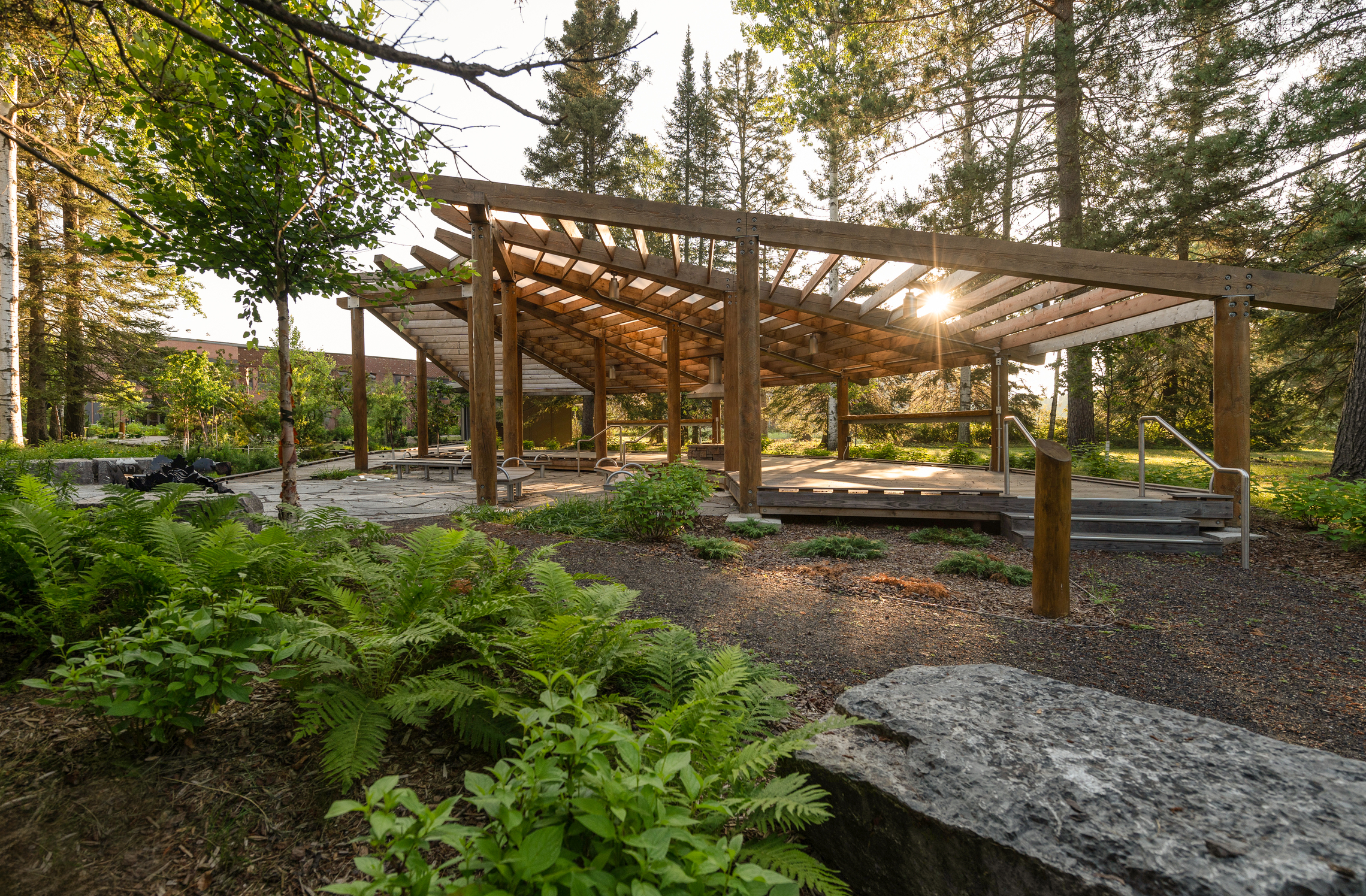
With those values in mind, the project began with listening. Bhavana and her team consulted students, faculty and facilities staff, using questionnaires and one-on-one conversations to understand how the space might be used. An underused C-shaped courtyard emerged as a key opportunity. Rather than push into the adjacent forest to create new outdoor space, Bhavana saw the courtyard as a place that could be reclaimed and transformed.
That decision was both practical and philosophical. The existing courtyard was not functioning well and needed improvement, but the choice also aligned with a deeper design principle. “You don’t hurt the land to make the space,” Bhavana said, describing the principle as central to Indigenous design thinking. In other words, the project’s strength came not from imposing on the site, but from responding to it.
The project was split into phases because of limited funding, and the first phase proceeded on a fast-track schedule. That pace required intense collaboration. It also demonstrated the advantage of having a larger, national practice behind the project, with local staff in Thunder Bay serving as the eyes on the ground while overall design was delivered from Winnipeg.
The national award is about more than one successful project. It is also a marker of what Bhavana and her colleagues have been building over time: a Landscape architecture and Urban Design practice capable of delivering meaningful, collaborative work with real impact.
In the end, the award recognizes both the project and the practice behind it. After years of work, the recognition came in one unforgettable phone call. It was a moment of joy, but also one that captured what the award meant to Bhavana and her team.